


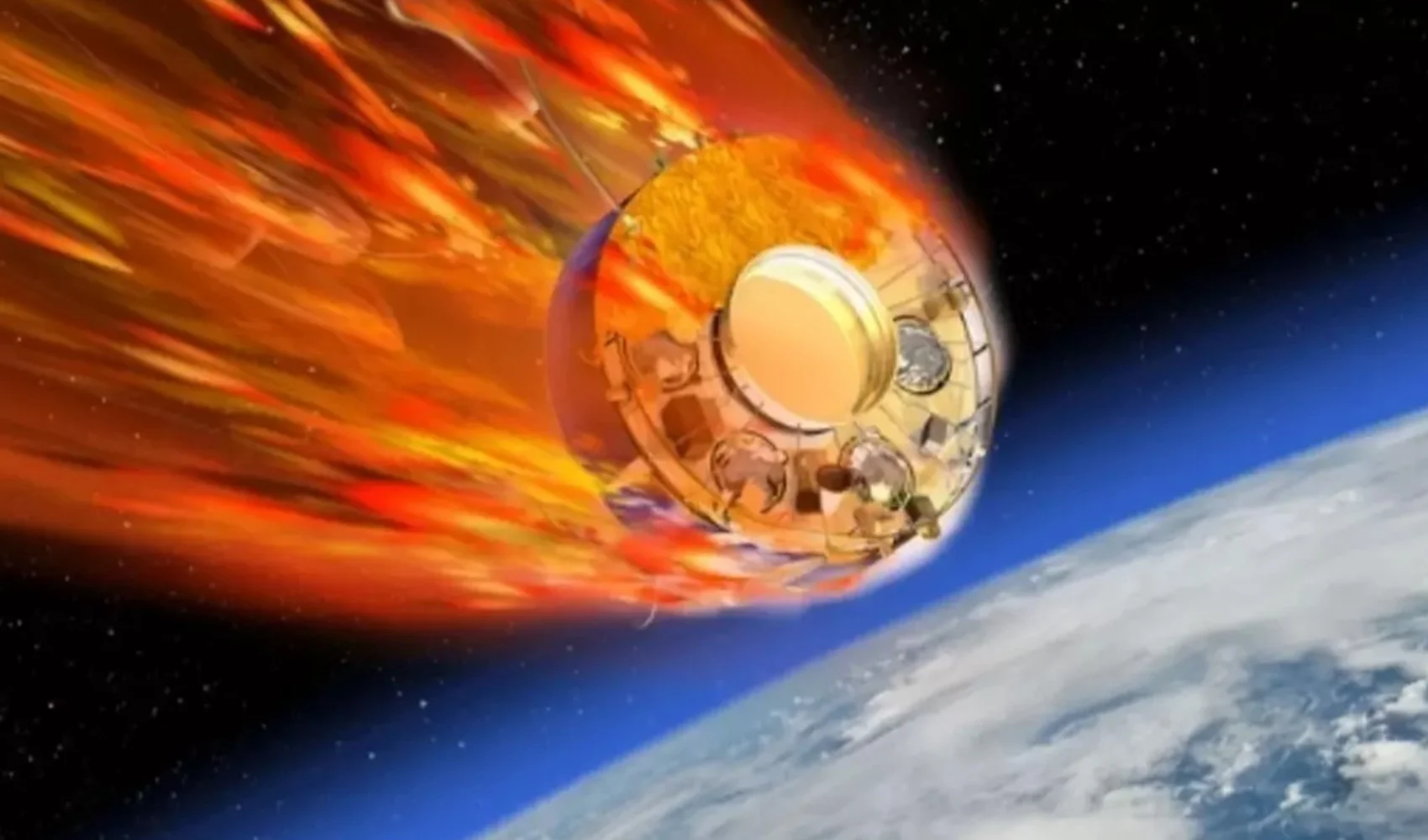
Overview of Kosmos 482
- Name: Kosmos 482 (also known as Venera 72B)
- Launch Date: March 31, 1972
- Launch Site: Baikonur Cosmodrome, Site 31/6
- Launch Vehicle: Molniya-M rocket with 4th stage (Blok-L)
Mission Objectives
Kosmos 482 was originally intended to be a Venus lander — part of the Soviet Union’s Venera program, which aimed to explore Venus. Its primary goals were:
- To enter Venus’ atmosphere
- To deploy a lander capable of descending to the surface
- To gather scientific data about atmospheric composition, pressure, and temperature
- To test high-temperature-resistant components for surviving Venus’ extreme surface conditions

What Went Wrong?
Although Kosmos 482 was designed for interplanetary travel, the spacecraft failed to leave Earth orbit due to a malfunction in its fourth-stage (Blok-L) upper booster.
- The booster failed to achieve escape velocity, and instead of heading toward Venus, Kosmos 482 was stranded in low Earth orbit (LEO).
- The orbital parameters were too low for interplanetary transfer but too high for immediate reentry.
Relation to Venera 8
Kosmos 482 was a sister spacecraft to Venera 8, which was launched just a few days later, on April 2, 1972, and successfully reached Venus, transmitting valuable data from the planet’s surface.
The fact that Venera 8 succeeded while Kosmos 482 failed highlights the risks and precision challenges in early interplanetary spaceflight.

Operational History & Remnants
- Though it failed its mission, Kosmos 482 became notable due to parts of the spacecraft reentering Earth’s atmosphere.
- In April 1972, just days after launch, some components, believed to be part of the descent module or structural parts, crash-landed in New Zealand, notably in Ashburton and near Waiouru.
- These parts were made of heat-resistant titanium, designed to survive the descent to Venus — hence they survived Earth reentry almost intact.
Some components remain in orbit today (as of 2025), with the descent module predicted by some to reenter Earth’s atmosphere sometime in the 21st century, depending on orbital decay.
Scientific Contributions
Although Kosmos 482 never completed its mission, its design and construction:
- Contributed to technological advancements in planetary entry probes
- Offered engineering insights used in Venera 8, which was a successful mission
- Helped refine heat shielding and pressure vessel design for future Venus landers

Notable Incidents
- Crash in New Zealand (1972):
- A few large metal fragments landed in rural areas, leading to local curiosity and press attention.
- The Soviet Union never officially confirmed their origin at the time, likely due to Cold War secrecy.
- Debris was later identified by experts as part of a Soviet interplanetary probe.
- Long-Term Orbiting Remnant:
- The main descent capsule is still in orbit.
- Due to its robust construction, some experts believe it may remain aloft for centuries unless intentionally deorbited.
Summary
| Feature | Detail |
|---|---|
| Mission Type | Venus lander (failed) |
| Program | Soviet Venera program |
| Launch Date | March 31, 1972 |
| Outcome | Failed to leave Earth orbit |
| Scientific Success | None directly; indirect via Venera 8 |
| Legacy | Engineering lessons; surviving debris and long-term orbital presence |


Leave a Reply